Why I Press Plants
Reading the Landscape One Flower at a Time
It's the second week of September and the chamisa has gone gold along every arroyo in town. Tansy aster in the road gravel; hairy golden aster and cowpen daisy holding on in the empty lots; sacred datura still opening at dusk and folding by mid-morning; threadleaf groundsel, its yellow blossoms on long stalks waving in the warm late-summer breeze; a few late Apache plume blossoms on a shrub that just keeps giving; the last of the annual sunflowers leaning over the fence. I know this because I wrote it down on Thursday. I keep a bloom list, most weeks, the way some people keep a bird list, and I have for years.
When people ask me why I press flowers, I usually say something about the beauty of them, which is true and also not the whole answer. The whole answer takes a little longer.
The First Wildflower I Pressed
The first flower I remember pressing was an elephanthead, in the summer of 1998, when I was working as an educator at the Teton Science School in Jackson, Wyoming. I'd never seen one before. It grows at altitude in wet ground, a tall stalk crowded with small pink flowers, and every one of them is, unmistakably, an elephant — trunk, forehead, two big ears flared out to the sides. I found a whole stand of them near an alpine lake with a wide wetland at one end, and I got down on my knees in the wet to admire them. I remember the smell of the water in the air and the grasses. The blue sky with puffy white summer clouds. I remember giggling at the sight of those silly, tiny, beautiful elephants.
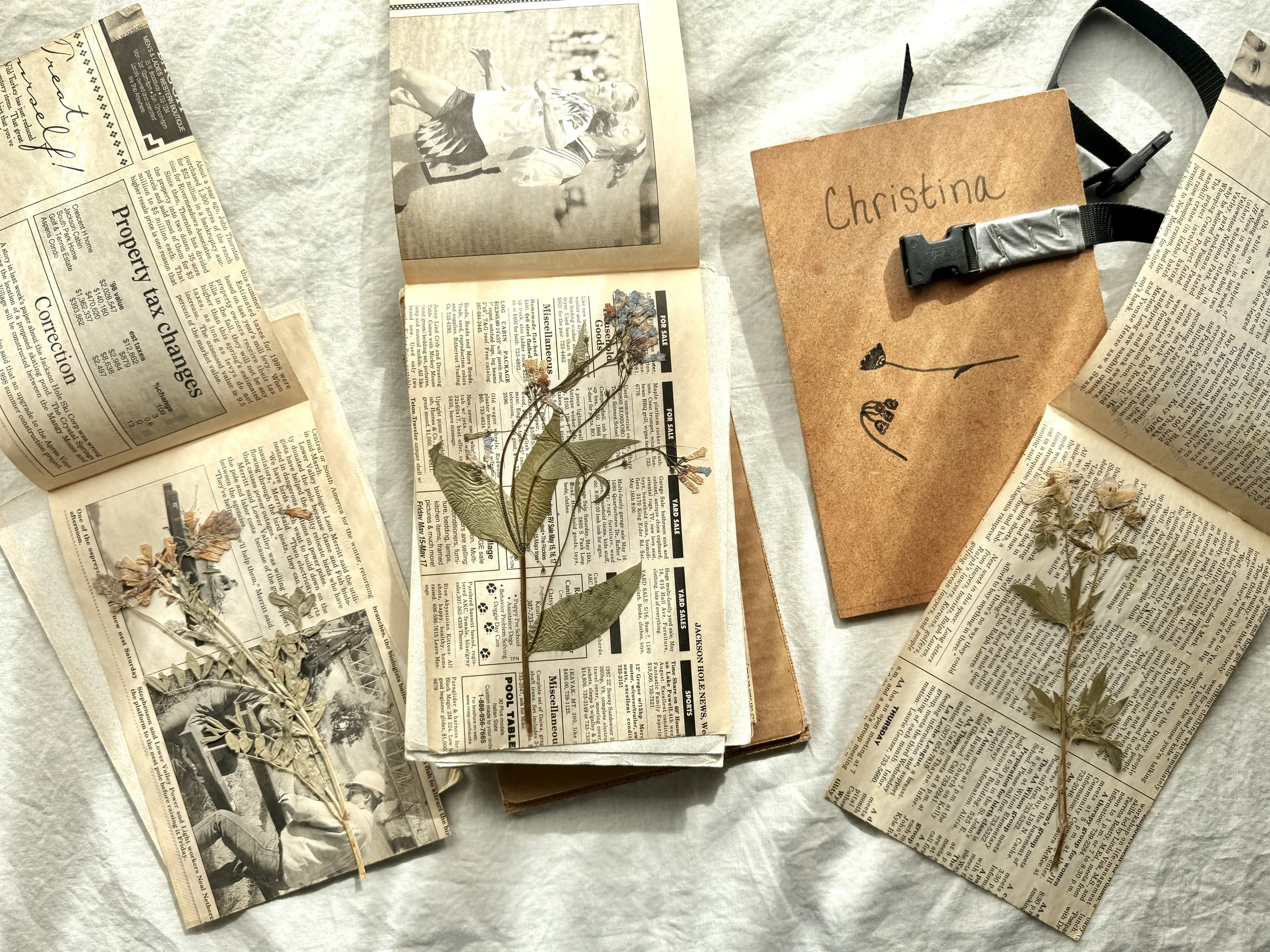
That press is still in my studio. I can open it today and there is the elephanthead, twenty-eight years faded to the color of weak tea, still between the sheets of newspaper I pressed it in that day, and I am back at that lake, on my knees, with the whole short alpine summer still ahead of me. That was what hooked me, before I had any words for it: that I could hold on to a season that only lasts six weeks. That a flat brown flower could keep a day, a feeling, an experience and make it present again every time I looked at it.
What a Herbarium Is For
I'd studied ecology, and what I learned first about plants was not their names but their company — the soil and the water and the slope they live on, the insects that visit them, the neighbors they bloom alongside, the whole story of where they are and what they're in relationship with. A flower on its own is a word. The meadow is the sentence; the larger habitat is the book chapter.
That's what a herbarium is, or can be: sheets of pressed plants, each with a label saying what it is, where it grew, and when someone stood in front of it and paid attention, and together they put the story back one word at a time. Botanists have kept them this way for a few hundred years. The big ones at universities hold millions of sheets; small ones, like the Carrizo Mountain Herbarium on the Navajo Nation (which a share of every Eufloria sale currently supports) hold several thousand. Taken together they are the closest thing we have to a written record of what the living world was doing in a given year on a given hillside. The scientists who made them weren't trying to make them pretty, though sometimes they are anyway. Mostly they were made so that a person a century later could read them.
I press for the same reason: to record the story, and over time, to understand it a little more deeply.
A New Mexico Year, Read in Wildflowers
My years of bloom lists and collecting are beginning to tell a story. Here is what a year where I live looks like when I read it in flowers. March starts the show in southern New Mexico, where after a winter of good snow and rain, the gold poppies light up the bajadas, followed by evening primroses that the sphinx moths visit at dusk. Up north, in April, the desert floor goes first while the high country is still under snow: pasqueflower around Easter, and Townsend's aster, a stemless beauty flat against the ground. By May the first red paintbrushes hit the foothills, and the sego lilies come after them.
By the second week of June the wet meadows in the Jemez are blue with Rocky Mountain iris — blue flag, the old-timers call it — and I'm up at the cabin kneeling in a seep counting plants before I take any. Sixty or seventy in bloom means I can take six. By the end of June over in the wetter Sangre de Cristos, the treeless ridges around Jicarita Peak are a riot of low-growing color, and no streamside anywhere is left unadorned. Early July is the peak up high: paintbrush reaching the alpine meadows, mariposa lilies filling the Valles Caldera, and if there's been recent fire, fireweed in the burn.
By August the bloom has climbed as high as it can go — Parry's gentian, that impossible blue, and arctic gentian at eleven and twelve thousand feet in the Pecos — and from there the bloom season begins its retreat. And then September, when everything comes back down to the valley and turns gold. Chamisa. Asters. The sunflowers going to seed.
Every one of those is a sheet in my press, and every sheet has a label. Lay them out in order on the studio table and you're looking at the year, told by the plants that lived it. Told, too, by the snowpack and the monsoon and the fire, because the plants don't bloom on a calendar; they bloom when the water comes and the conditions are right. Some years the iris are up by mid-May. Some years the snow decides. This past year, there wasn't enough of it. A neighbor at the cabin told me about winters when it drifted eight feet high, to the eaves, and we both looked at the dry meadow and wondered. The sheets remember which kind of year it was. It's why my collections in the studio have started carrying names like June in a Jemez Mountain Meadow and August on Elk Mountain instead of colors. A month and a place is where a wildflower's story starts.
When the Years Stop Resembling Each Other
I'm writing all of this down partly because it moves me. I've spent years visiting, photographing, and collecting in the alpine country of the Southern Rockies, and what the plants up there are saying is plain enough: the snow is less and goes earlier, the bloom follows the melt uphill, and the flowers that live above treeline have nowhere higher to go. Down in the valley — last year's wet meadow is a dry meadow now, iris bloomed a few weeks ahead of where my old lists put them. The neighbor's snowdrifts exist only in his stories. None of that is a reason to stop noticing. It's a reason the looking counts more. A sheet in a press is a record of one year in one place, and when the years stop resembling each other, that record is worth more, not less. Someone a century from now who loves the meadows by my cabin after me will want to know what was blooming in a Jemez meadow in June of 2026.
That's the part that keeps me doing it. A single pressed flower is a moment. A herbarium is a story, and the story only makes sense over time. Ten years of iris sheets from the same wet meadow would tell you something about that meadow that no single visit can — whether the bloom is coming earlier, whether the population is holding, what the year after a dry winter looks like. I log my collections on iNaturalist and in my own database for exactly this reason, and I've come to think of the sheets in the press as the same record in a form I can hold. You don't have to be an ecologist to read it. You just have to keep the sheets together and keep going back and keep looking.
But I digress into the part where I get to be an amateur botanist. There's another reason, and it's simpler.
Slow Craft: How a Pressed Flower Becomes an Heirloom
Pressing is slow, and I like slow. A flower spends six weeks between blotter sheets before it comes out. Before that there's the walk to find it, which is never as short as I think it will be; the kneeling; the counting; the choosing of which six out of sixty. After that there's changing the blotter, and the waiting, and the day the press finally opens and the thing inside is either what I hoped or something better or a brown disappointment (all three have happened). Then the mounting, by hand, on watercolor paper that was also made by hand, in India or South Korea, by people who also work slowly and carefully. Then the label, written or typed out. None of it can be hurried. I have tried. The flower doesn't care what week I need it by.
And slow is where the craft lives. The elephanthead is the color of weak tea because in 1998 I put it between two sheets of newspaper and closed the press. Twenty-eight years later I know a little more. I know which flowers want to be in the press within the hour and which will forgive a night in a jar of water; which ones hold their color for years and which go brown no matter what you do; how much pressure a gentian can take and how little a mariposa lily can; when to change the blotter, and how many times. I know how to lay a stem so it keeps the way it grew — the lean of it, a bud beside the open flower, one leaf turned to show its underside — because a plant flattened is not the same thing as a plant pressed. Then the paper, acid-free and made by hand, so it won't yellow around the specimen in twenty years. Then the label, which is what turns a pretty thing into a record. I'm still learning. Every season I try something new on last year's failures, and some of those experiments turn into beautiful art. That is the difference between a flower in a book and a sheet that will outlast me. Both hold a day. Only one of them was made to be handed down.
And, it's fun. It is a good way to spend an afternoon. You go outside. You look closely at something small. You come home with a handful of stems and a wet knee and a name you didn't know before — a new flower friend — and six weeks later you have made a beautiful thing.
Why I Press, and Why It Matters
Somewhere in my musings is the answer to why I press. It sounds a bit like a bumper sticker, but it's true. You can't love what you've never stood in front of. And you don't take care of what you don't love. Kneeling in a wet meadow counting iris is not a retreat from whatever is going wrong in the world; it's the beginning of the only response that keeps me and the natural world healthy. Being present with the living landscape. Writing down the names of those I encounter. Coming back next year to see if they're still there. Getting my hands dirty to help them along the way where I can.
"Our lives attain a new level of enrichment when we gain the ability to recognize as friends the plants and animals of our own environment. We can go through the seasons expecting encounters with them at times and places magically predestined. They greet us on every hand and add dimensions of meaning and belonging to every outdoor experience." — Robert DeWitt Ivey, beloved New Mexican botanist and illustrator, in the opening of his Flowering Plants of New Mexico
That's the more complete answer to why I press, more or less. Getting to know a place by its flowers. Keeping a record of the seasons, so that the years can talk to each other. Slowing down enough to notice, and keeping a record of what I was paying attention to. Deepening the relationship, even if everyone else lets go. And making something with my hands at the end of it that carries all of that inside it — the date, the meadow, the elevation, the water that year, and a person on her knees in the soil, feeling for a moment like part of the place instead of a visitor — our story.
That last part is what the art is for, if it's for anything. It's not about the wildflower, exactly. It's about the moments of being human in the wild and knowing it. I felt this in the moment at the lake in the Tetons in 1998 and I've been trying to bring people into the feeling ever since. My botanical sheets leave the studio with a label on them to mark those moments. And they are pressed the way it has taken me twenty-eight years to learn, so the color lingers long into the years and the form stays eternal. If a botanical sheet makes someone look a little more carefully at the landscape the next time they step outside, or remember a lake of their own next to which they felt what it is to be a human in the wide, beautiful world, that's most of what I'm after.
My press is full right now with a bit of everything from the roadsides this week — globemallow, cowpen daisy, morning glories from the garden — and next to it, still, the elephanthead in my first press, twenty-eight years on, reminding me of what I love and want to care for.
Every botanical sheet in the studio is a real plant, gathered by hand in the Southwest, pressed for six weeks or more, and mounted with a label noting what it is, where it grew, and when. They are made to be kept together, and to be handed down. View the collection →