Field Notes from the Jemez & Sangre de Cristo Mountains
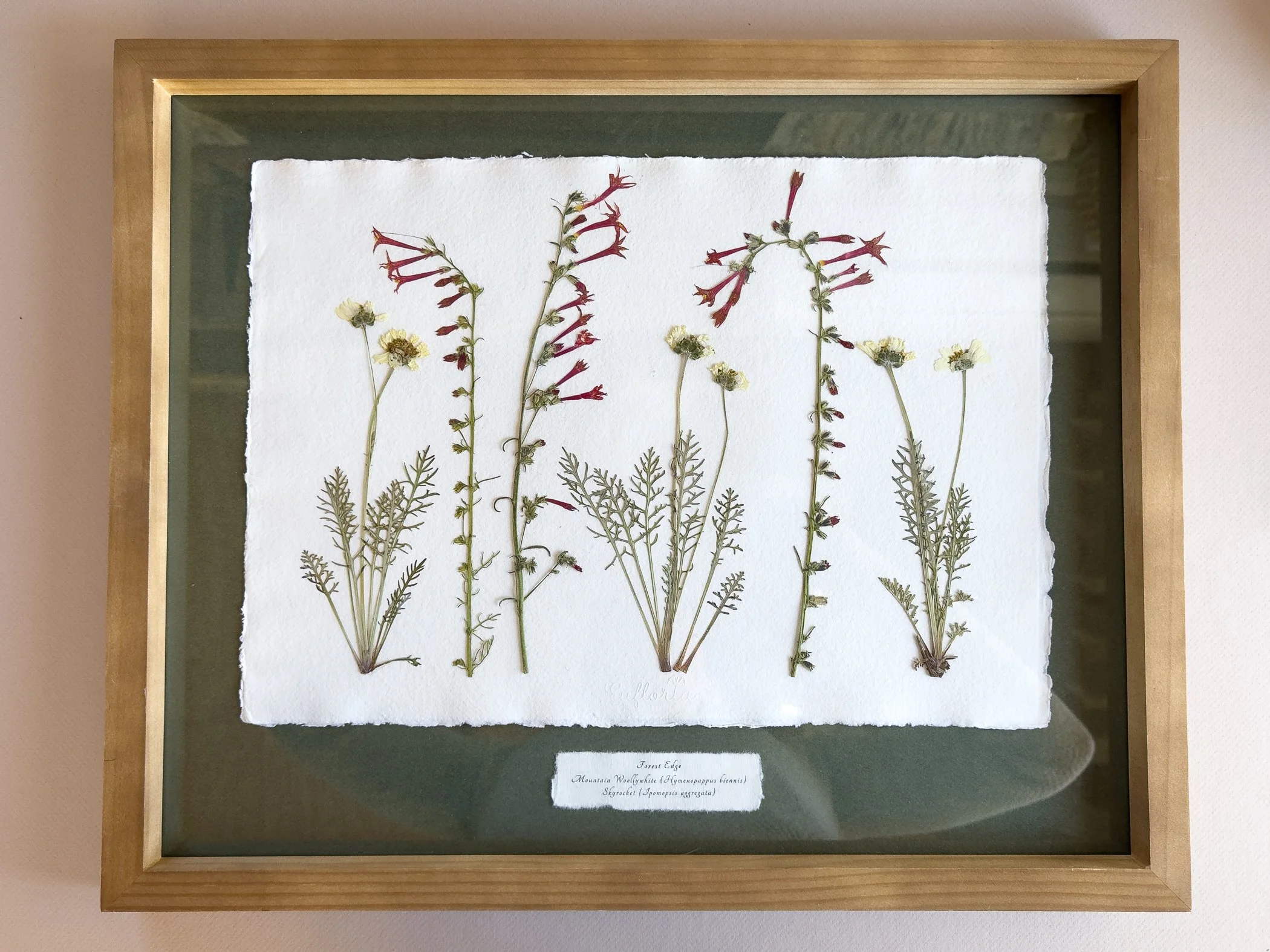
Natural companions “- At Forest’s Edge” - From the Jemez Mountains - 16×20 artwork - $425
Why Two Mountain Ranges at the Same Elevation Tell Very Different Ecological Stories
A botanical field essay on place, plants, and ecological memory from northern New Mexico.
Something I’ve noticed over years of hiking between the Sangre de Cristo and Jemez Mountains—and especially through living at my cabin in the Jemez over the last four summers—is that the wildflowers, plant communities, and overall sense of habitat are different between these two ranges, they feel like entirely different ecologies unfolding across the land.
At first glance, the elevations appear comparable, and yet the lived reality of these places shifts in ways that become more obvious the longer you spend time moving through them. What looks like a shared altitude on a map reveals itself, on the ground, as two distinct climates shaped by very different relationships to moisture, temperature, soil, and time itself.
In the Sangre de Cristo Mountains, the landscape seems to hold water longer, while in the Jemez Mountains, the environment feels more immediate, more responsive, and more shaped by cycles of rapid change that come and go with the monsoon, the sun, and the volcanic ground beneath it.
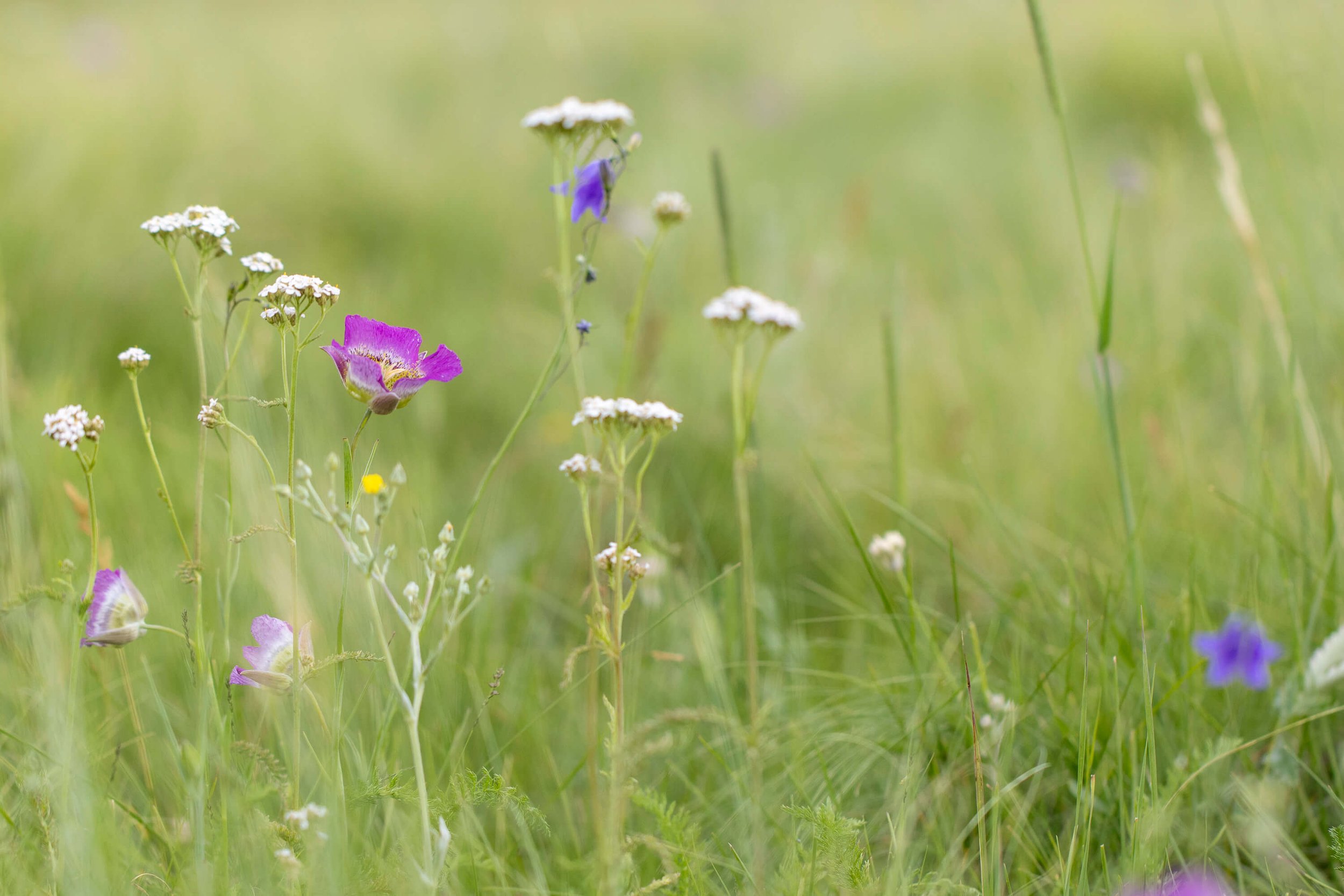
The Sangre de Cristo Mountains: A Cool, Moist Alpine Ecology
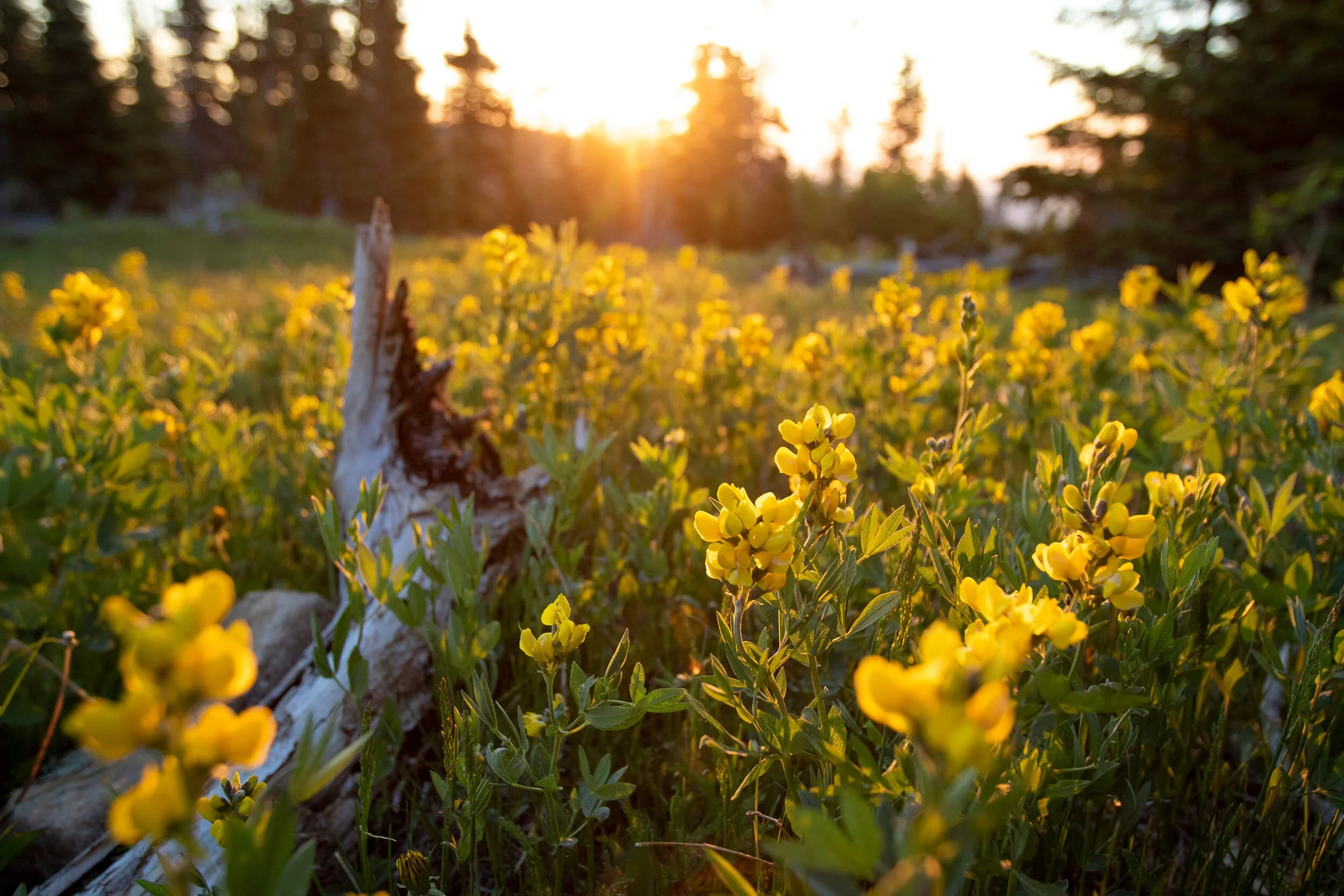
Golden banner growing in a large colony in a meadow at 10,000’ in the Sangre de Cristo Mountains
The Sangre de Cristo Mountains in northern New Mexico tend to hold moisture for longer periods of time, shaped by their position within a broader Rocky Mountain alpine system where snowpack, elevation, and gradual seasonal melt cycles define the ecological rhythm of the landscape.
In these higher-elevation Sangre de Cristo environments, forests are dense and layered, with spruce and fir creating shaded, cool understories where New Mexico wildflowers often develop slowly and persist later into the growing season. Even in summer, the landscape carries a lingering alpine coolness, as if winter moisture is still present within the soil and air.
Snowmelt in the Sangre de Cristo Mountains tends to be gradual, feeding streams, meadows, and forest floors in a steady way that supports longer growing cycles. As a result, alpine and subalpine wildflowers in New Mexico often have extended bloom periods here, especially in protected meadows that retain moisture well into late summer.
The ecological pattern in the Sangres is one of accumulation—snow, moisture, organic matter, and time building gradually into a stable mountain ecosystem.
The Jemez Mountains
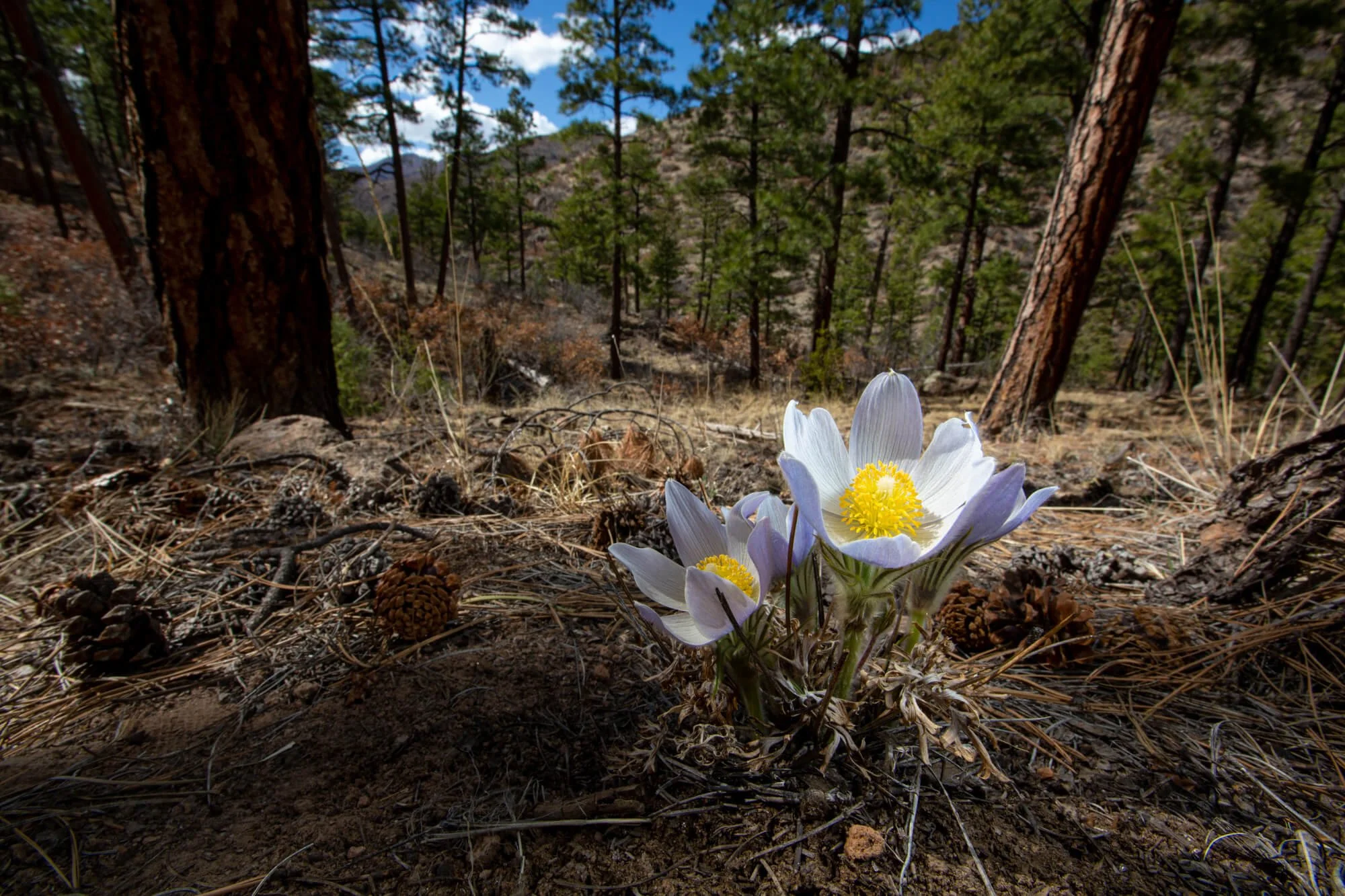
Pasqueflower, one of the first wildflowers to emerge in the spring in the dry Ponderosa forests of the Jemez Mountains.
The Jemez Mountains, by contrast, feel structurally and ecologically more volatile, shaped by their volcanic origins and their direct exposure to surrounding high desert and basin air masses. Even at comparable elevations, conditions shift more quickly here—heat returns sooner after storms, soils drain rapidly, and moisture tends to be more episodic and closely tied to the timing of monsoon patterns rather than sustained seasonal retention.
This creates a landscape where growth is often concentrated into bursts of intensity rather than extended periods of steady development. Summer rains can trigger sudden waves of green across slopes and canyons, but those same areas may begin to dry again relatively quickly as sun exposure and wind increase evaporation. Fire history is also embedded into this system in a very visible way, shaping patterns of regrowth and creating mosaics of forest, grassland, and open volcanic terrain that continue to evolve over time.
What emerges is a sense of responsiveness rather than accumulation—an ecosystem that is constantly recalibrating itself around cycles of moisture, heat, disturbance, and regrowth, where plants are continually negotiating between abundance and scarcity within the same growing season.
Why Elevation Alone Doesn’t Explain Ecology
One of the most important ecological insights from moving between the Sangre de Cristo Mountains and the Jemez Mountains is that elevation alone does not determine habitat, climate, or plant behavior in northern New Mexico.
While elevation is often used as a shorthand for climate, New Mexico mountain ecology is far more dependent on moisture availability, soil composition, snow persistence, microhabitats, and exposure to wind, sun, and monsoon systems.
Wildflowers make this difference especially visible. In the Sangre de Cristo Mountains, New Mexico wildflower seasons tend to unfold more gradually due to longer-lasting moisture and snowmelt. In the Jemez Mountains, wildflower blooms are more episodic, often appearing rapidly after monsoon rains and fading just as quickly as conditions dry.
In both ranges, plants are not simply growing in place—they are actively responding to ecological signals such as rainfall timing, fire history, soil type, and temperature shifts. Each species becomes a record of its specific environment, shaped by the unique conditions of its mountain range.

Golden pea pressed, mounted on watercolor paper and labeled. A memory of an ecology at a point in time.
Ecology as Botanical Art
This is where ecological observation becomes inseparable from botanical art.
In my work at Eufloria Botanic Art, pressed botanical art is not only about preserving New Mexico plants visually, but about preserving ecological moments from specific landscapes across northern New Mexico.
Each pressed plant becomes a record of place—capturing the conditions under which it grew, including rainfall patterns in the Jemez Mountains, snowmelt cycles in the Sangre de Cristo Mountains, soil composition, elevation, and seasonal timing.
A pressed flower is not just a botanical specimen. It is ecological documentation. It is a fragment of New Mexico landscape history preserved through botanical art practice.
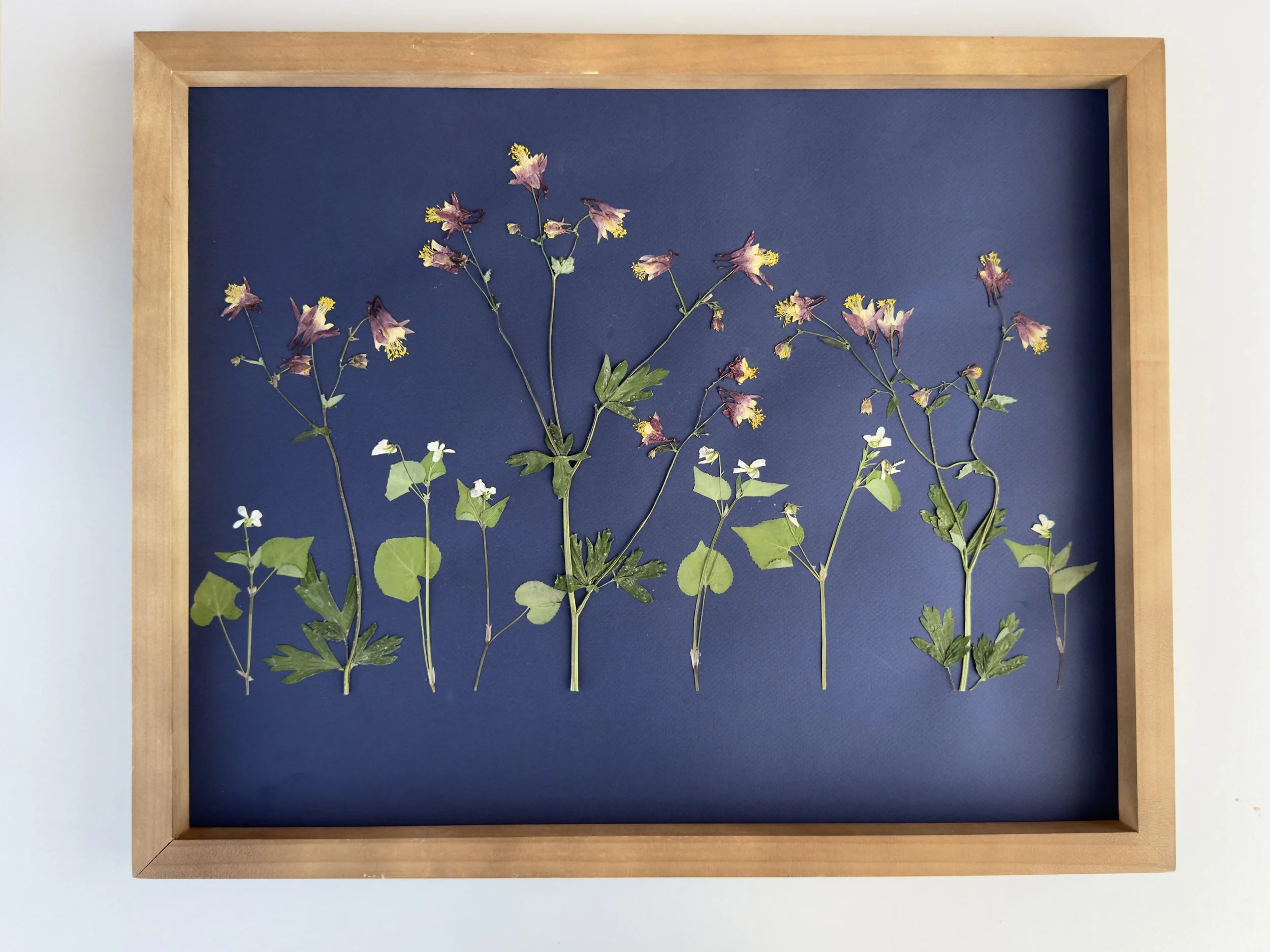
Red columbines and Canadian violets growing together in the shady forests of the northern portion Sangre de Cristo Mountains in New Mexico.
About Eufloria Botanic Art
Eufloria Botanic Art is a fine art botanical studio based in Santa Fe, specializing in one-of-a-kind pressed plant artworks created from native Southwestern flora.
Plants are gathered ethically and by hand from the Jemez Mountains, the Sangre de Cristo region, and surrounding Southwestern landscapes, as well as from cultivated garden spaces. Each specimen is preserved using traditional botanical pressing techniques and transformed into framed botanical compositions.
With a background in ecology, my practice sits at the intersection of ecological science, botanical art traditions, and contemporary fine art, with a strong focus on New Mexico and Southwestern landscapes, wildflowers, and ecology-based storytelling.
Why Botanical Art Matters in the Southwest
Botanical art preserves what is otherwise fleeting in Southwestern landscapes—seasonal wildflower blooms, ecological relationships, monsoon-driven ecological shifts, snowmelt cycles, and fire-influenced regrowth across mountain ecosystems.
In rapidly changing climates, pressed botanical works become ecological archives. They preserve not only the appearance of New Mexico plants, but the conditions that shaped them, offering a visual record of how landscapes like the Jemez Mountains and Sangre de Cristo Mountains are shifting over time.
These works function as both fine art and ecological memory—bridging science, place, and material beauty.
Join Eufloria’s Field Notes List
If you are interested in botanical art specializing in plants of the Southwest, pressed plant work, and ecological storytelling from the Jemez, Sangre de Cristo Mountains and beyond, you are welcome to join the Field Notes list for seasonal updates, studio releases, and new ecological essays from the field.