New Collection: Plants for Spiritual Protection
In honor of Eufloria’s Guardian Plants collection, this is a bit about these plant helpers and why they’re worth working with.
Across cultures and centuries, certain plants have been kept at doorways. Not for decoration. Lavender hung above a window in medieval Europe, vervain laid on a Roman altar, marigolds whose orange is bright enough to guide spirits home on Día de los Muertos. St. John’s Wort, hung over doorways in medieval Europe to absorb the evil eye and keep nightmares from the bed. Heather, carried in Celtic country as a traveler’s charm, a plant that grows where little else will. The particulars differ, but the gesture is the same: a plant placed at the threshold, marking where the outside world ends and the inner one begins.
You don’t have to believe a dried flower cleans the energy of a room to feel the sense of that. A plant at the entryway is a small instruction to yourself. Pause here. Leave what happened out there. What follows is the folklore behind the guardians that grow where I live and I gather and press myself. Those that don’t grow in wild where I collect haven’t entered the Eufloria collection. But the impulse behind them is the same.
Eufloria’s Guardian Collection
The Guardian Plant Collection currently includes six plants: Lavender, Larkspur, Vervain, Geranium, Cosmos, and Poppy. These are plants that, historically and across cultures, have been used to keep the energy of a space, a person, or a home clean. Each is a real pressed specimen, gathered by hand in New Mexico and framed to hang in an entryway or in the transition spaces between outside and inside. The list grows as I am introduced to, verify, and am able to grow or collect more guardian plants.
Each Guardian Plant is an original: this plant, gathered on one particular day in New Mexico, pressed to herbarium standard, framed to hang at a threshold of your choosing.
The Guardians
1. Lavender (Lavandula angustifolia)
Lavender is one of the most widely known flowers with protective properties. In European folklore, it was believed that lavender could purify the air and ward off evil spirits. Its pleasant scent was thought to drive away negativity and promote peace within the home. Lavender was often placed in doorways or hung in bunches above windows to protect against dark forces. In addition to its spiritual uses, lavender was also considered a powerful charm for love and healing, further reinforcing its status as a flower of protection.
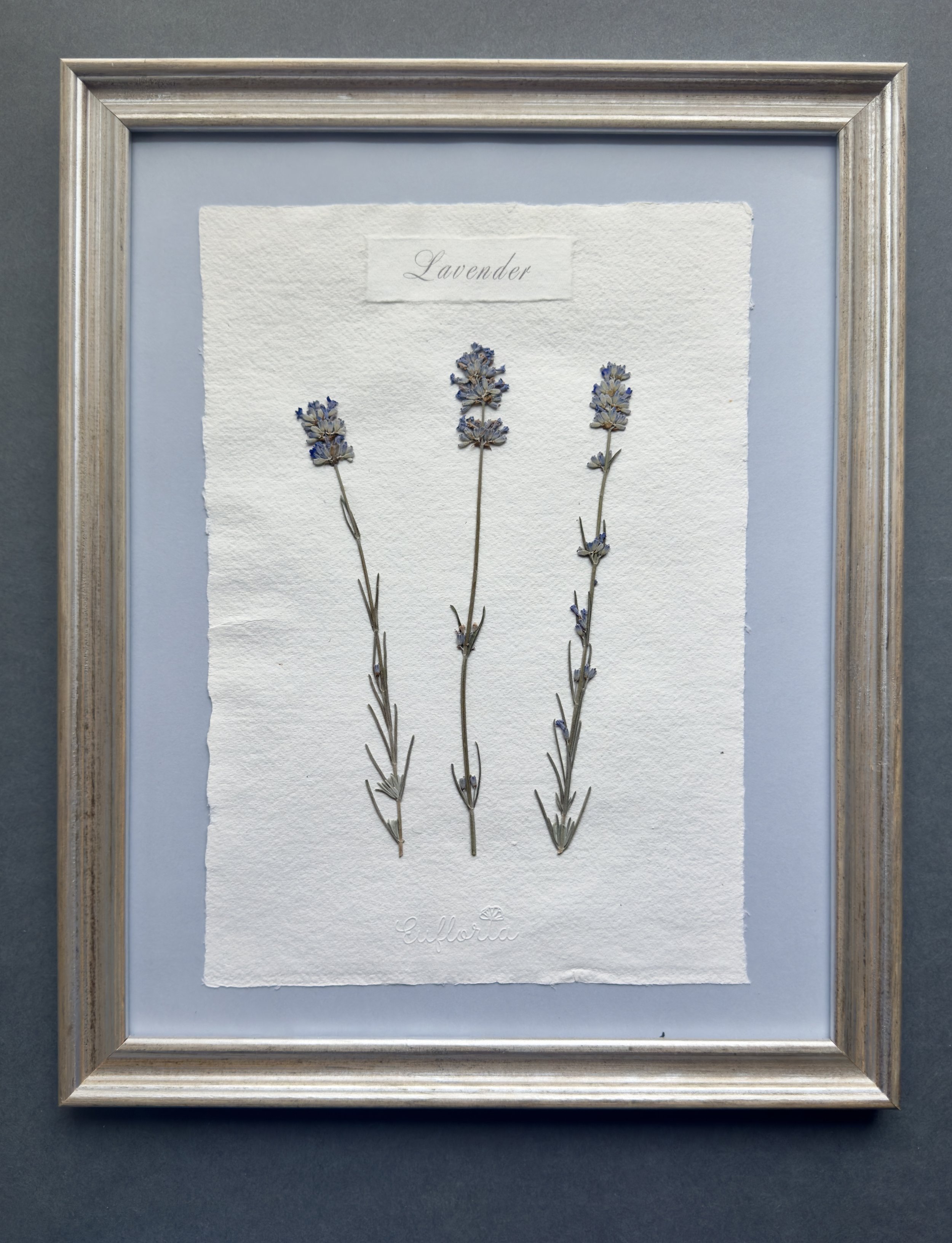
Lavender has been a plant of calm, clarity, and care across cultures for centuries — used to ease anxiety, promote sleep, and purify spaces from ancient Egypt to medieval Europe. Its silvery stems and violet-blue flowers carry one of the most universally beloved fragrances in the natural world.
This original pressed botanical artwork captures Lavender hand-gathered in New Mexico, mounted on handmade Indian watercolor paper with the plant’s common name hand-lettered in calligraphy on a separate piece of watercolor paper at the top of the composition. The Eufloria mark is embossed at the base. Framed in a champagne-colored frame with a soft grey mat.
Part of the Guardian Plant Collection — a series of botanicals chosen for their deep cultural, spiritual, and ecological significance. Each piece comes with a Flower Story Card describing the plant’s natural history, folklore, and spiritual uses.
Beautiful in a bedroom, bathroom, or any space where you want to invite rest and calm.
This is an original pressed plant artwork — not a print or reproduction. Only 3 available.
What’s included
One original pressed Lavender — a real specimen, so yours will differ slightly from the one pictured. Mounted on handmade Indian watercolor paper, A4 (8.25 × 11.75"), with the common name hand-lettered in calligraphy. Framed in a champagne-colored 11 × 14" frame with a soft grey mat, wired and ready to hang. A Flower Story Card with the plant’s natural history and folklore is tucked in with it. Ships from Santa Fe within 3–5 business days; shipping is calculated at checkout.
The Guardian Plant Collection currently includes six plants: Lavender, Larkspur, Vervain, Geranium, Cosmos, and Poppy. These are plants that, historically and across cultures, have been used to keep the energy of a space, a person, or a home clean. Each is a real pressed specimen, gathered by hand in New Mexico and framed identically — champagne-colored frame, soft grey mat, and the plant’s common name hand-lettered in calligraphy — so they hang beautifully together at an entryway or in the transition spaces between outside and inside. Collect two or more and contact me for a bundle discount.
Every purchase gives back: 10% of profits support the Navajo-led Carrizo Mountain Herbarium in New Mexico.
2. Larkspur (Delphinium sp.)
Larkspur, with its vibrant color and tall, upright structure, has long stood for an open heart and a positive outlook. Traditionally it is associated with love, protection, and spiritual growth. Historically, larkspur was believed to ward off evil spirits and bring good luck, and in folklore it was carried as a protective charm against harm and negativity. Its symbolism also reaches toward exploration, discovery, and new horizons: lightness, laughter, carefree energy, and a reminder to celebrate the simple joys of life.
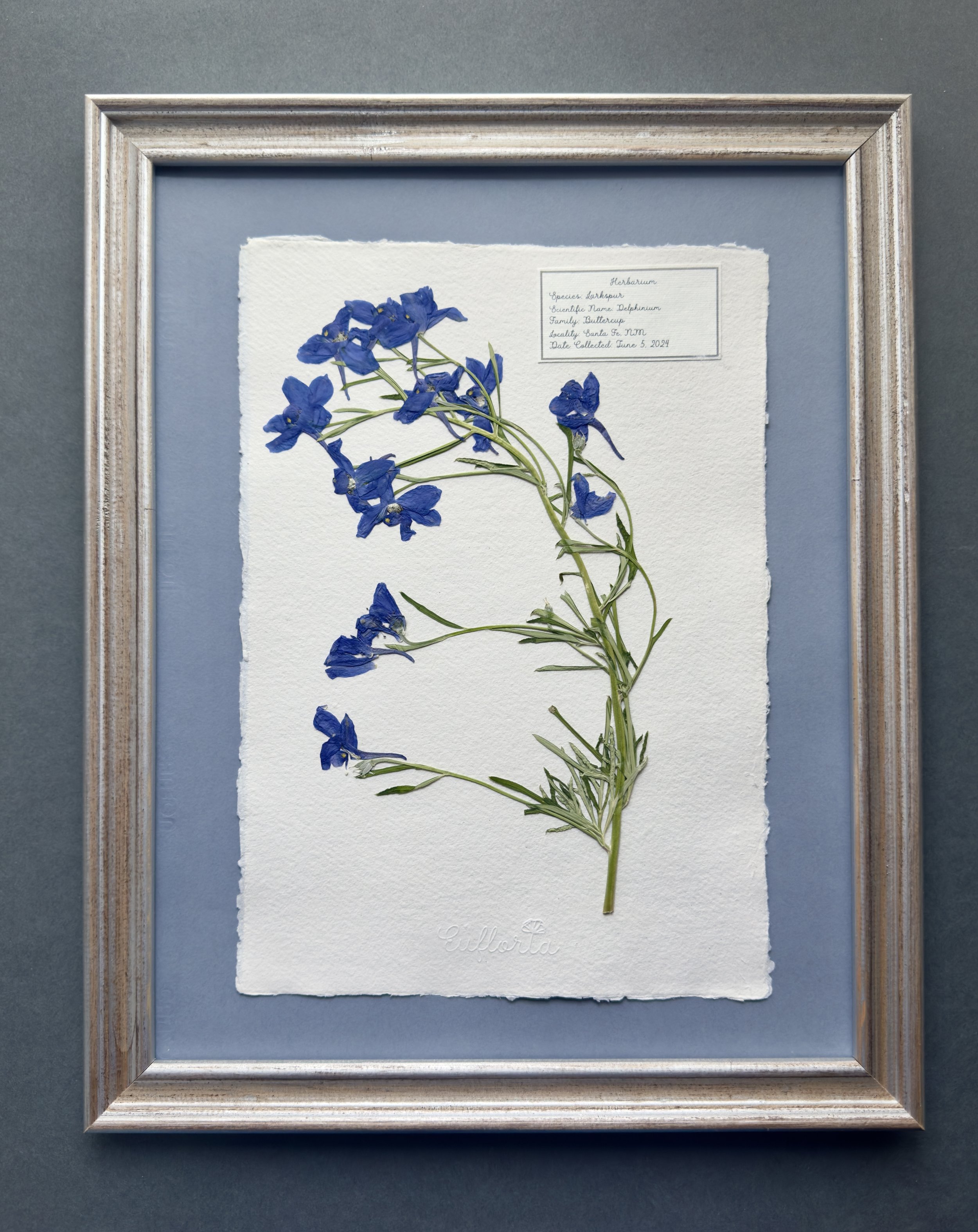
This listing is for a real pressed Larkspur from the Guardian Plant Collection.
The Guardian Plant Collection currently includes six plants: Lavender, Larkspur, Vervain, Geranium, Cosmos, and Poppy. These are plants that, historically and across cultures, have been used to keep the energy of a space, a person, or a home clean. Each is a real pressed specimen, gathered by hand in New Mexico and framed identically — champagne-colored frame, soft grey mat, and the plant’s common name hand-lettered in calligraphy — so they hang beautifully together at an entryway or in the transition spaces between outside and inside. Collect two or more and contact me for a bundle discount.
A Flower Story Card is included with your purchase that tells the natural history, folklore, and spiritual uses of the plant and explains why it merits a place at the threshold.
Plants are mounted on handmade watercolor paper imported from India. Each is embossed with the Eufloria mark at the bottom of the paper. The plant’s common name in calligraphy is included on a separate piece of watercolor paper at the top of the mounted plant. The watercolor paper is then top matted onto fade-resistant colored art paper. Mat color is light grey with a champagne colored frame.
What’s included
One original pressed Larkspur — a real specimen, so yours will differ slightly from the one pictured. Mounted on handmade Indian watercolor paper, A4 (8.25 × 11.75"), with the common name hand-lettered in calligraphy. Framed in a champagne-colored 11 × 14" frame with a soft grey mat, wired and ready to hang. A Flower Story Card with the plant’s natural history and folklore is tucked in with it. Ships from Santa Fe within 3–5 business days; shipping is calculated at checkout.
We suggest hanging these in an entryway or transition spaces between outside and inside or into your inner sanctuary like a bedroom or rooms used for meditation or spiritual practice.
For more about Guardian Plants read this blog entry about the Collection.
Add additional Guardian Plants to your order for a discount of up to 20%.
3. Vervain (Verbena officinalis)
Vervain, also known as the Enchanter’s Herb, has a long association with magical and spiritual practice, reaching back to the ancient Egyptians, Greeks, and Romans as well as the Celtic Druids. Its primary role was to protect believers against evil spells or negative energy and to purify sacred places: altars, ceremonial implements, temples, and private dwellings.

Vervain has been called a sacred herb across cultures for thousands of years — used by the Druids, revered in ancient Rome, and woven into folk medicine traditions from Europe to the Americas. Known as a plant of protection, purification, and peace, it has long been placed at thresholds and hearths to guard the home and calm the spirit.
This original pressed botanical artwork captures Vervain (Verbena) hand-gathered in New Mexico, mounted on handmade Indian watercolor paper and framed in a champagne-colored frame with a soft grey mat. The plant’s common name is hand-lettered in calligraphy on a separate piece of watercolor paper at the top of the composition, and the Eufloria mark is embossed at the base — a quiet signature of handcraft and intention.
Part of the Guardian Plant Collection — a series of botanicals chosen for their deep cultural, spiritual, and ecological significance. Each piece comes with a Flower Story Card describing the plant’s natural history, folklore, and spiritual uses.
Hang it in an entryway, bedroom, or meditation space — anywhere you want to bring a sense of calm and protection.
This is an original pressed plant artwork — not a print or reproduction. Only 1 available.
What’s included
One original pressed Vervain — a real specimen, so yours will differ slightly from the one pictured. Mounted on handmade Indian watercolor paper, A4 (8.25 × 11.75"), with the common name hand-lettered in calligraphy. Framed in a champagne-colored 11 × 14" frame with a soft grey mat, wired and ready to hang. A Flower Story Card with the plant’s natural history and folklore is tucked in with it. Ships from Santa Fe within 3–5 business days; shipping is calculated at checkout.
Each piece is top-matted — the handmade watercolor paper with its deckled edges sits on top of the mat, keeping the plant and paper fully visible.
The Guardian Plant Collection currently includes six plants: Lavender, Larkspur, Vervain, Geranium, Cosmos, and Poppy. These are plants that, historically and across cultures, have been used to keep the energy of a space, a person, or a home clean. Each is a real pressed specimen, gathered by hand in New Mexico and framed identically — champagne-colored frame, soft grey mat, and the plant’s common name hand-lettered in calligraphy — so they hang beautifully together at an entryway or in the transition spaces between outside and inside. Collect two or more and contact me for a bundle discount.
Other traditions kept their own guardians. St. John’s Wort, hung over doorways in medieval Europe to absorb the evil eye and keep nightmares from the bed. Marigold, whose orange is bright enough to guide spirits home. Heather, carried in Celtic country as a traveler’s charm, a plant that grows where little else will. None of these grow wild where I collect, so none have entered the Eufloria collection. But the impulse behind them is the same one that shaped it.
4. Geranium (Geranium sp.)
There are more than four hundred species of annual, biennial, and perennial plants commonly known as geraniums or cranesbills, found throughout the temperate regions of the world and the mountains of the tropics, with the greatest diversity in the eastern Mediterranean. Purple Geranium and Richardson’s Geranium are common wild varieties in the western U.S., with many cultivars grown in home gardens. Geranium is a plant of hearth and emotional balance. It is said to help release stuck negative emotions and promote healing, creating an atmosphere of peace and steadiness, and its presence is thought to support inner growth and emotional clarity.
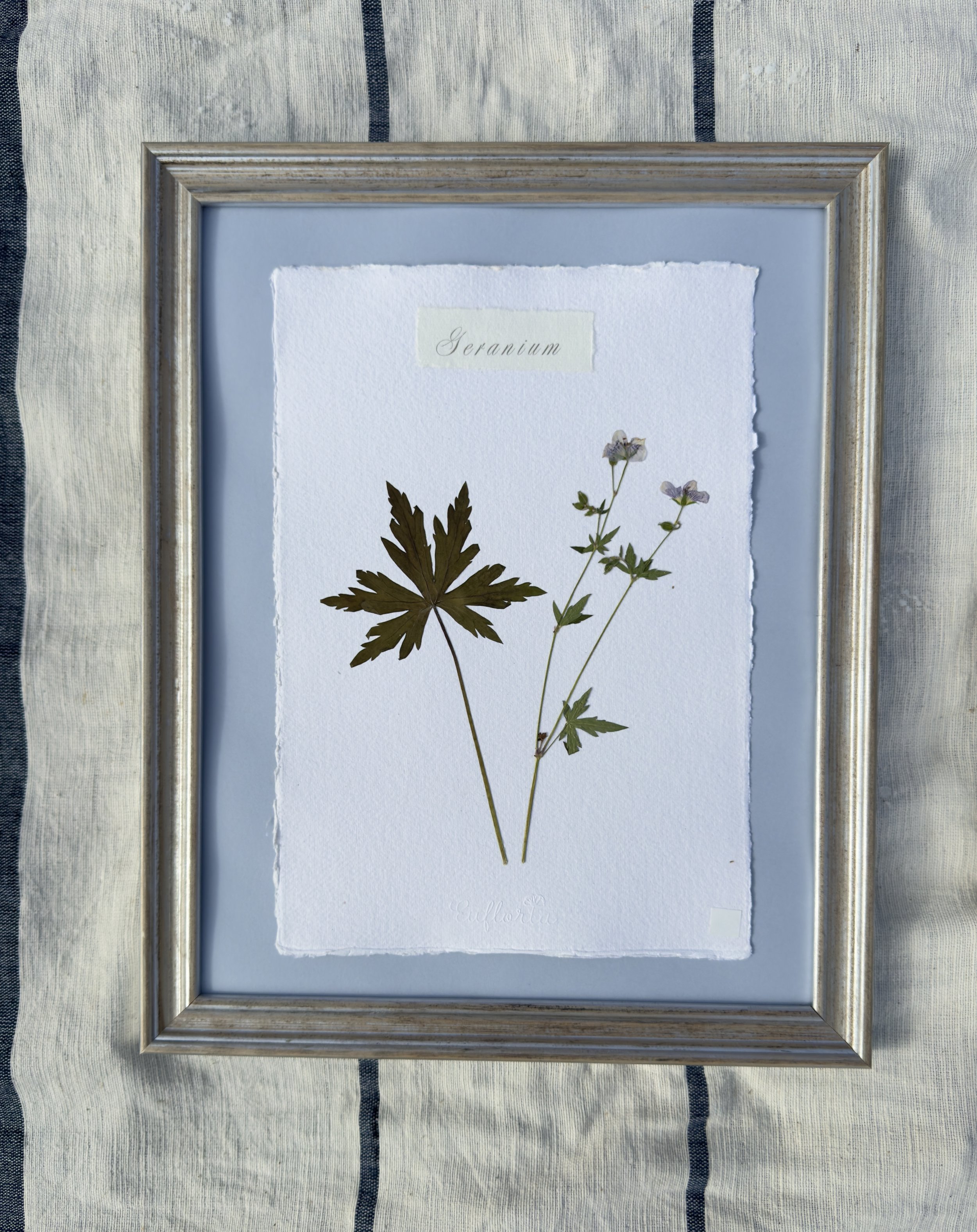
Geranium has been a plant of hearth and home for centuries — used across cultures to cleanse spaces, lift the spirit, and protect the household. With its deeply lobed leaves and vivid pink blooms, it carries both beauty and a long lineage of care.
This original pressed botanical artwork captures Geranium hand-gathered in New Mexico, mounted on handmade Indian watercolor paper with the plant’s common name hand-lettered in calligraphy on a separate piece of watercolor paper at the top of the composition. The Eufloria mark is embossed at the base. Framed in a champagne-colored frame with a soft grey mat.
Part of the Guardian Plant Collection — a series of botanicals chosen for their deep cultural, spiritual, and ecological significance. Each piece comes with a Flower Story Card describing the plant’s natural history, folklore, and spiritual uses.
Hang it in an entryway, kitchen, or any space you want to feel grounded and cared for.
This is an original pressed plant artwork — not a print or reproduction. Only 3 available.
What’s included
One original pressed Geranium — a real specimen, so yours will differ slightly from the one pictured. Mounted on handmade Indian watercolor paper, A4 (8.25 × 11.75"), with the common name hand-lettered in calligraphy. Framed in a champagne-colored 11 × 14" frame with a soft grey mat, wired and ready to hang. A Flower Story Card with the plant’s natural history and folklore is tucked in with it. Ships from Santa Fe within 3–5 business days; shipping is calculated at checkout.
Each piece is top-matted — the handmade watercolor paper with its deckled edges sits on top of the mat, keeping the plant and the paper fully visible rather than covered.
The Guardian Plant Collection currently includes six plants: Lavender, Larkspur, Vervain, Geranium, Cosmos, and Poppy. These are plants that, historically and across cultures, have been used to keep the energy of a space, a person, or a home clean. Each is a real pressed specimen, gathered by hand in New Mexico and framed identically — champagne-colored frame, soft grey mat, and the plant’s common name hand-lettered in calligraphy — so they hang beautifully together at an entryway or in the transition spaces between outside and inside. Collect two or more and contact me for a bundle discount.
5. Cosmos (Cosmos bipinnatus)
Cosmos takes its name from the Greek kosmos, meaning order and harmony, a name Spanish mission priests in Mexico gave it for the evenness of its petals. In the language of flowers it stands for peace, balance, and modest joy, and it has long been grown at garden gates and along paths, a plant that thrives on neglect and keeps blooming until frost. A cosmos at the threshold is a small reminder that order can be simple, and that what is left alone often does fine.
Cosmos, pressed and framed · $150
6. Poppy (Eschscholzia californica)
Poppies have been bound up with sleep, rest, and remembrance since the Greeks placed them with Hypnos and Morpheus. The California poppy, the one that grows wild in the West, closes its petals each evening and in cloudy weather, which earned it a reputation as a plant that knows when to rest. Spanish settlers called it copa de oro, cup of gold, and Indigenous peoples of California used it for its calming qualities. At a doorway it asks the same thing of you: set it down, whatever it is, at least for the night.